
When a fentanyl screen comes back negative, it is easy to assume no synthetic opioid is present. With carfentanil, that assumption can be wrong. This ultra-potent fentanyl analog may be active at amounts so small that many routine screens are not designed to see it. For clinicians, the question is not only whether carfentanil is present, but whether the test in use can find it at all.
What Is Carfentanil?
Carfentanil is a synthetic opioid and fentanyl analog first developed as a veterinary tranquilizer for very large animals, marketed under the brand name Wildnil. It is the “elephant tranquilizer” often referenced in news coverage, and it is not approved for human use. So what is carfentanil used for today? Legitimately, only large-animal sedation. In the illicit drug supply, it appears as an adulterant mixed into heroin, fentanyl, or cocaine, or pressed into counterfeit pills that look like prescription painkillers. People who use these drugs often do not know it is there.
Carfentanil vs Fentanyl: Potency Changes the Testing Problem
The DEA estimates carfentanil is roughly 10,000 times more potent than morphine and 100 times more potent than fentanyl, which is why it is sometimes described as a drug “stronger than fentanyl” or “super fentanyl.” The DEA notes that a nearly microscopic amount of carfentanil can be deadly. That potency has a direct consequence for testing. Because so little drug is needed to cause harm, the amount that reaches blood and urine is also very small. In one published case report, urine contained carfentanil at 2.88 ng/mL, while plasma levels fell below 0.01 ng/mL, the lower limit of the method used (Allibe et al., 2019). A drug that acts in microscopic amounts leaves traces measured in nanograms and picograms. A test is only as useful as the lowest concentration it can reliably see.
The Numbers Behind the Concern
Carfentanil is not new. The U.S. saw earlier surges in 2016 to 2017 and again in 2019 to 2020. What is new is how quickly it has returned. CDC data show overdose deaths with carfentanil detected rose from 29 in January to June 2023 to at least 238 in January to June 2024, roughly a sevenfold increase. Carfentanil was detected in at least one death in 37 states, and from July 2023 to June 2024, 86.9% of carfentanil-involved deaths also involved illegally manufactured fentanyl (Tanz et al., 2024)
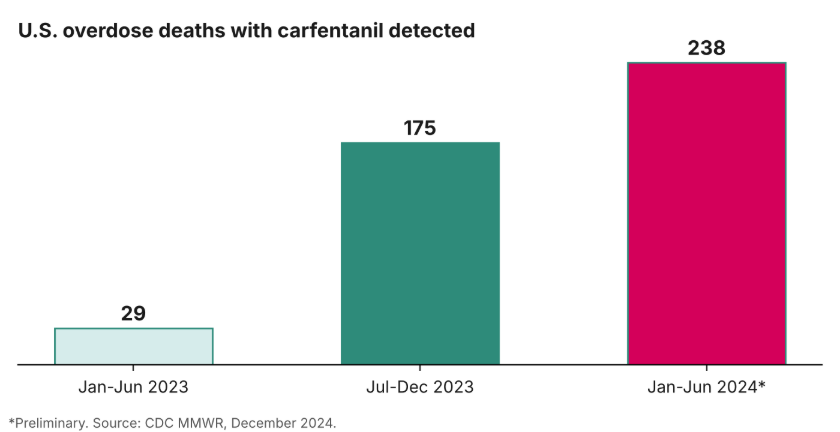
Seizure data point the same way. DEA laboratories tested more than 100 kg of seized material containing carfentanil in 2024 alone, more than the roughly 87 kg seized over the prior three years combined. Most 2024 seizures were pills rather than powder (DEA, 2025). The CDC also notes that postmortem toxicology testing lacks standardization across jurisdictions, so the true count is likely higher than reported.
Why Standard Screens Can Miss Carfentanil
Most rapid fentanyl tests are immunoassays built around fentanyl itself. Cross-reactivity with fentanyl analogs varies, and carfentanil is a known gap. In a 2022 validation study, a fentanyl test strip failed to detect carfentanil at or below 1,000 ng/mL in solution (Park et al., 2022). That is far above the 2.88 ng/mL of carfentanil found in urine in the case report above (Allibe et al., 2019).
Laboratory research co-authored by Gregory A. Hobbs, PhD, now Laboratory Director at Acutis Diagnostics, points to the same gap. When blank urine was spiked with carfentanil, a urine fentanyl immunoassay showed only low-level positivity at 100 ng/mL and no positivity with 100 ng/mL of norcarfentanil. The authors considered that assay of minimal value for urine carfentanil, since patient levels are likely to be much lower (Tuzel et al., 2020). At the time of that report, no commercially available presumptive test for carfentanil existed.
Three other factors make detection harder:
- Uneven mixing. Carfentanil is often poorly blended into other drugs, creating “hot spots.” One pill from a batch may contain a dangerous amount while another contains little or none.
- Co-detection with fentanyl. Because most carfentanil cases also involve fentanyl, a fentanyl-positive result can mask carfentanil exposure. A result that names the specific analog gives clinicians more context than a general fentanyl positive.
- Metabolite overlap. Carfentanil is metabolized to norcarfentanil, but norcarfentanil is also a metabolite of remifentanil, an anesthetic used in hospitals. Finding the metabolite alone may not prove carfentanil use, so identifying the parent drug matters for accurate interpretation (Allibe et al., 2019; Tuzel et al., 2020).
The table below shows how common detection methods compare.
| Method | Typical sensitivity | Best used for |
| Immunoassay test strips | Nanograms per milliliter (ng/mL); may miss carfentanil entirely | Rapid, preliminary screening and harm reduction |
| Ion mobility spectrometry (IMS) | Trace residues on surfaces and packaging | Non-contact screening of surfaces and packages in the field |
| LC-MS/MS | Down to picograms per milliliter (pg/mL) | Definitive laboratory confirmation in clinical and forensic toxicology |
Carfentanil in Living Patients: What Treatment-Setting Cases Show
Most carfentanil cases have been identified after death. Two published reports co-authored by Dr. Hobbs show what trace-level testing can reveal while patients are still in care.
In a 2020 case report in the Journal of Analytical Toxicology, a patient enrolled in substance use disorder treatment and prescribed Suboxone® relapsed with heroin. LC-MS/MS testing of her urine found norcarfentanil at 5.4 ng/mL, while carfentanil itself was present at only 0.48 ng/mL, below the laboratory reporting limit of 1.0 ng/mL. She did not know she had taken carfentanil or fentanyl. When the laboratory alerted the clinic, staff contacted her right away for medical evaluation. To the authors’ knowledge, it was the first documented carfentanil exposure in New York State (Tuzel et al., 2020).
The exposure was detected only through definitive testing for norcarfentanil. As the authors note, a survivor of carfentanil exposure would probably not even realize it had happened.
A 2021 letter in The American Journal of Drug and Alcohol Abuse described a larger pattern. In a single methadone opioid treatment program in Central New York, seven patients tested positive for carfentanil and/or norcarfentanil by LC-MS/MS between October 2020 and January 2021, with 12 positive results across 166 specimens from 119 patients. Carfentanil was found incidentally, not because of a reported overdose. All seven patients said they did not know they had used it, and four tested positive before starting methadone treatment (Szczesniak et al., 2021).
Both reports point to the same conclusion. Patients exposed to carfentanil may not know it, and laboratory testing may be the only way to find out. The authors called for tests sensitive enough to detect carfentanil and norcarfentanil at very low concentrations, prompt communication from the laboratory to the clinician, and greater surveillance and harm reduction in treatment programs.
Why Trace-Level Detection Matters
For treatment centers and MAT programs, knowing a patient was exposed to carfentanil changes the risk conversation. The DEA notes that a carfentanil overdose may require multiple doses of naloxone, and reversal is not guaranteed. A specific result can support overdose prevention planning, naloxone access, and closer follow-up, as the treatment-setting cases above show.
- For pain management and behavioral health practices, an unexpected carfentanil finding may signal exposure to the illicit supply that a standard panel would not show.
- For first responders and forensic teams, carfentanil can pose serious exposure risk. Unknown powders should be treated as high risk until confirmed by a laboratory.
- For public health, trace-level testing helps close the gap in overdose surveillance, so emerging threats are seen earlier and counted more accurately.
In each case, the result should support, not replace, clinical judgment. Collection timing, dose, urine concentration, and individual metabolism can all affect what a test finds.
Key takeaway
A negative fentanyl screen does not rule out carfentanil. Definitive, trace-level testing that identifies the specific analog gives clinicians the context they need to assess overdose risk and act.
Carfentanil Rarely Travels Alone
Carfentanil is one of several fentanyl analogs circulating in the drug supply. Others include acetyl fentanyl, acryl fentanyl, and para-fluorofentanyl. Each has a slightly different structure, and each may cross-react differently, or not at all, with a standard fentanyl screen. A testing strategy that looks for named analogs, not just fentanyl, can give a more complete picture of what a patient was exposed to.
Carfentanil Testing at Acutis Diagnostics
A negative fentanyl screen does not rule out carfentanil. At Acutis, definitive toxicology testing can give clinicians more context than a screen alone. Acutis Diagnostics tests for carfentanil as part of its fentanyl-related synthetic opioid testing, alongside acetyl fentanyl, acryl fentanyl, and para-fluorofentanyl, as well as fentanyl and fentanyl analogs. Because a result names the specific analog, it can help treatment centers, pain management practices, and behavioral health programs see what a patient was exposed to and plan their next steps.
About Acutis Diagnostics
Acutis Diagnostics provides comprehensive clinical toxicology solutions for treatment centers and healthcare providers supporting patients with substance use disorders. Our testing helps clinicians detect emerging synthetic opioids, monitor treatment adherence, and make informed care decisions.
To learn more about carfentanil testing or to add fentanyl analog testing to your panel, contact service@acutis.com or visit acutis.com.
References
1. Tanz LJ, Stewart A, Gladden RM, Ko JY, Owens L, O’Donnell J. Detection of Illegally Manufactured Fentanyls and Carfentanil in Drug Overdose Deaths: United States, 2021-2024. Morbidity and Mortality Weekly Report. 2024;73(48). DOI: 10.15585/mmwr.mm7348a2.
2. U.S. Drug Enforcement Administration. Carfentanil: A Synthetic Opioid Unlike Any Other. May 14, 2025.
3. Park JN, Sherman SG, Sigmund V, Breaud A, Martin K, Clarke WA. Validation of a Lateral Flow Chromatographic Immunoassay for the Detection of Fentanyl in Drug Samples. Drug and Alcohol Dependence. 2022;240:109610.
4. Tuzel T, Bollini SM, Antara JP, Banks JF, Hobbs GA. Carfentanil Use in a Patient Undergoing Treatment for Substance Use Disorder. Journal of Analytical Toxicology. 2020;44:618-622.
5. Szczesniak LM, Hobbs GA, Sullivan RW. Detection of Carfentanil in a Cluster of Patients Without Associated Mortality: Response to Chhabra et al. The American Journal of Drug and Alcohol Abuse. 2021.
6. Allibe N, Fouilhe Sam-Lai N, Willeman T, et al. Norcarfentanil: Carfentanil Misuse or Remifentanil Treatment?. Forensic Toxicology. 2019;37:488-495.